SpaceOf.

Breaking Silos: Creating Connected, Decentralized Organizations
Blogs




By
Greg Varner

If there’s one thing we’ve learned at SpaceOf.Foundation, it’s that silos can be a silent killer of innovation and collaboration.
We’ve seen it happen firsthand—teams working in isolation, decisions getting bottlenecked, and brilliant ideas never reaching the right people. And in today’s fast-moving world, organizations can’t afford that kind of disconnect.
Breaking down silos isn’t just a management exercise; it’s a fundamental shift in how we work together. It’s about fostering trust, enabling autonomy, and ensuring that information flows freely. We’ve made it our mission to help organizations move toward decentralized, connected ways of working. Here’s how we approach it.
The Real Cost of Silos
Silos often form without anyone noticing. A team interprets the overall strategy in isolation, prioritizes its own goals, or operates independently as systems don’t talk to each other. Before you know it, information gets trapped, collaboration slows down, and opportunities slip through the cracks.
We’ve worked with organizations that struggled with this challenge. The symptoms are always similar—misalignment, duplicated efforts, slower decision-making, and a general sense of disconnection among employees. More than just inefficiency, silos create frustration. Teams feel unheard, innovation takes a hit, and even the best talent can start looking for the door.
And yet, many businesses still operate under outdated hierarchical models that reinforce these barriers. But here’s the truth: breaking silos isn’t just about fixing workflows. It’s about shifting the mindset of an entire organization.
The Shift: From Control to Collaboration
At SpaceOf.Foundation, we’ve helped organizations embrace continuous transformation through sustained collaboration. This isn’t a one-time change—it’s an ongoing commitment to openness, trust, and shared purpose.
We approach this transformation through our Impulse → Change → Build → Improve framework, guiding teams toward more decentralized and transparent ways of working.
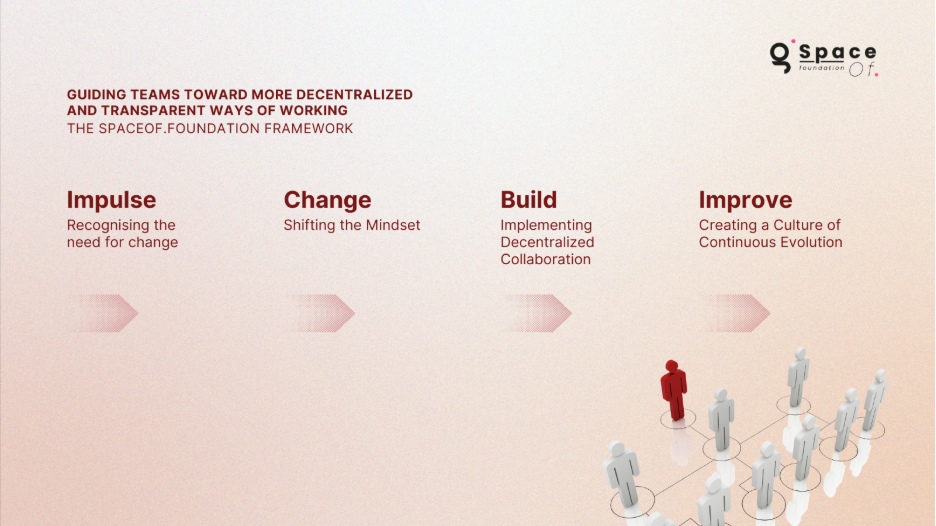
Impulse: Recognizing the Need for Change
- Identify where silos exist and the friction they create
- Assess their impact on efficiency, employee experience, and innovation
- Define a clear vision for a connected, decentralized organization
- Align leadership to drive the transformation forward
Change: Shifting the Mindset
- Move from top-down control to collaborative autonomy
- Foster psychological safety where teams feel empowered to communicate freely.
- Align leadership around shared goals instead of departmental KPIs
- Introduce collaborative technology and redesign workspaces to support open communication
Build: Implementing Decentralized Collaboration
- Establish cross-functional teams to bridge departmental gaps
- Introduce decision-making frameworks that distribute authority and trust
- Leverage shared digital workspaces to enhance transparency
- Implement training programs and incentives that reward collaboration
Improve: Creating a Culture of Continuous Evolution
- Embed collaboration into daily operations to prevent regression
- Encourage ongoing dialogue to refine and adapt ways of working
- Celebrate successes that arise from cross-team efforts
- Measure progress through engagement, project completion, and customer satisfaction metrics
Going Beyond Internal Collaboration
Breaking silos doesn’t just improve internal operations—it transforms how organizations interact with customers, partners, and the industry as a whole.
When teams are connected, customer service improves, product development cycles shorten, and businesses can adapt faster to market changes.
A decentralized and open approach fosters a culture of knowledge-sharing beyond company walls, encouraging partnerships and co-creation. Businesses that adopt this mindset don’t just survive disruptions; they lead the way in their industries.
Moreover, when employees feel part of an interconnected system, they are more engaged, creative, and willing to contribute beyond their defined roles. Instead of merely executing tasks, they collaborate to drive the organization’s vision forward.
What’s Next? The Future is Decentralized
The future of work isn’t about rigid structures—it’s about connection, transparency, and trust. Organizations that master collaborative models will be more agile, innovative, and resilient. They’ll be the ones that attract top talent, stay ahead of market shifts, and create exceptional customer experiences.
Breaking silos isn’t just an initiative; it’s a necessity. And the sooner organizations embrace this shift, the faster they’ll thrive in an ever-changing world.







